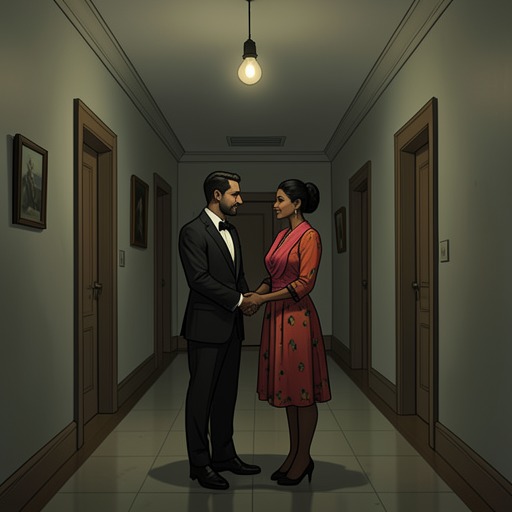
Peter Radley and Helen Radley's marriage
The RadleysPeter Radley and Helen Radley’s marriage is a long partnership shaped by secrecy, blood abstinence, and a widening gap between physical closeness and emotional intimacy. They share a household and children, yet their history of affection does not protect them from estrangement: Peter longs to recover an intimacy they once shared, while Helen carries secrets and reacts to his advances with fatigue and reserve.
Identity and History
Peter and Helen are spouses whose relationship reaches back at least to 1992, when they were preparing to marry. On March 13 of that year, Peter told his brother that he had told Helen everything. He also described their plans: a June wedding at the registry office, followed by Helen’s wish to be converted on their honeymoon. The account places disclosure and a prospective transformation close to the formal beginning of their married life, making knowledge of vampirism part of the relationship’s foundation rather than a late discovery between them.
Their marriage later includes children, and Peter considers whether they should tell a daughter the truth. The evidence does not specify the full content of what he proposes to reveal in that moment, but the question establishes that the couple’s private history has consequences for how they parent. Their life together therefore involves not only a bond between spouses but also decisions about what the next generation should know.
Affection, Secrecy, and Physical Intimacy
A small nighttime scene exposes the imbalance between Peter’s desire for contact and Helen’s state of mind. Helen returns to bed tense with secrets; Peter responds with a yearning sigh and nuzzles her. She asks him to leave her alone because it is the middle of the night and she has a headache. His tenderness is real, but it reaches her when she is burdened and unwilling to engage. The scene lets domestic familiarity and concealed strain occupy the same bed.
Peter later thinks of the sex he wanted the previous night as harmless, ordinary human intimacy, separate from the appetite for blood. He reasons that he might have hoped it would lead further, but that he had contained himself for seventeen years. That span makes restraint a defining condition of their relationship: for Peter, self-control has been sustained over much of their shared life, yet the effort does not erase his desire or the frustration attached to it. His distinction between sex and blood also reveals how vampirism has altered the terms of marital closeness. What might otherwise be ordinary affection carries the shadow of a more dangerous appetite.
Peter proposes that they tell a woman the truth, while Helen’s response to his advances remains guarded. The juxtaposition suggests a marriage in which disclosure is repeatedly at issue: what to reveal, to whom, and when. Their relationship is not simply defined by what they know about one another, but by the secrets they still carry and the family decisions those secrets demand.
Estrangement and the Return of Will
The marriage’s tension becomes explicit when Will is expected to stay until the following day. Peter is angry that Helen has changed her position about Will, though he cannot clearly identify what, beneath the immediate dispute, is making him so angry. He describes their effort to paper over the cracks as futile when the cracks have grown so wide. His uncertainty matters: the conflict is not reducible to a single disagreement, because Will’s presence touches a deeper dissatisfaction that Peter himself struggles to name.
Peter frames the problem as a loss of shared life. He complains that he and Helen no longer taste each other’s blood and that, apart from going to the theater to see long plays, they do little together. He recalls earlier occasions in Tuscany, the Dordogne, and at Christmas at Helen’s mother’s home, using those places and gatherings to measure how far their intimacy has receded. His appeal is not only for a ritual restored; it is a claim that they have stopped acting as partners in a distinctive part of their shared existence.
That complaint leads him to imagine an empty future after the children leave for university: just the two of them, trapped in what he regards as a bloodless marriage. The phrase condenses the conflict between the conventions of domestic life and the vampire bond that once gave their relationship a different form. Peter wants renewed connection, but his way of describing that need also shows how much he associates intimacy with blood. Helen’s hesitation over Will and Peter’s anger about it unfold against this broader sense that the marriage has lost its former vitality.
Disclosure, Conversion, and Family Consequences
The 1992 account links Helen’s knowledge of Peter’s secret with a specific future she desired: conversion on their honeymoon. This detail makes the marriage’s history inseparable from the question of what Helen would become. It also stands in sharp contrast to Peter’s later insistence that he has spent seventeen years containing himself. The couple’s shared life is thus marked both by a decision once imagined as part of their future and by long discipline around the desires and practices bound up with vampirism.
Their choices reach beyond the marriage. Peter’s suggestion that they tell a daughter the truth makes the household a place where their concealed identity may need to be acknowledged. Later, while Helen explains to Jared what giving blood to Eve would mean, she stresses that conversion is likely to create very strong feelings toward the person whose blood is used. Although this discussion concerns Eve rather than Peter and Helen’s own conversion, it clarifies the stakes of the blood relationship that had figured in their marriage plans: blood can establish an emotional attachment as well as change a person’s condition. The novel’s wider treatment of conversion therefore gives added weight to the couple’s old plans and to Peter’s longing to taste Helen’s blood again.
The Marriage’s Central Conflict
Peter and Helen’s relationship holds together opposing meanings of restraint. Peter treats seventeen years of containment as evidence that he has mastered his impulses, yet his complaints show that restraint has not produced contentment. He misses a form of intimacy that joined blood, shared history, and pleasure. Helen, by contrast, appears in the cited moments burdened by secrets, a headache, or concern over Will; her withdrawal is not explained as a settled rejection of Peter, but it leaves his need for closeness unanswered.
The marriage is consequently presented neither as a simple failure nor as an uncomplicated romance. Its early history includes disclosure, a planned wedding, and Helen’s wish for conversion; its later life includes children, a proposed family revelation, and Peter’s fear that the couple have become little more than companions in a stalled routine. The recurring contrast between blood and bloodlessness gives that distance its particular shape. Peter’s plea for renewed intimacy exposes how much he still wants the marriage to mean, while Helen’s secrets and decisions show that their shared history cannot be repaired by desire alone.